
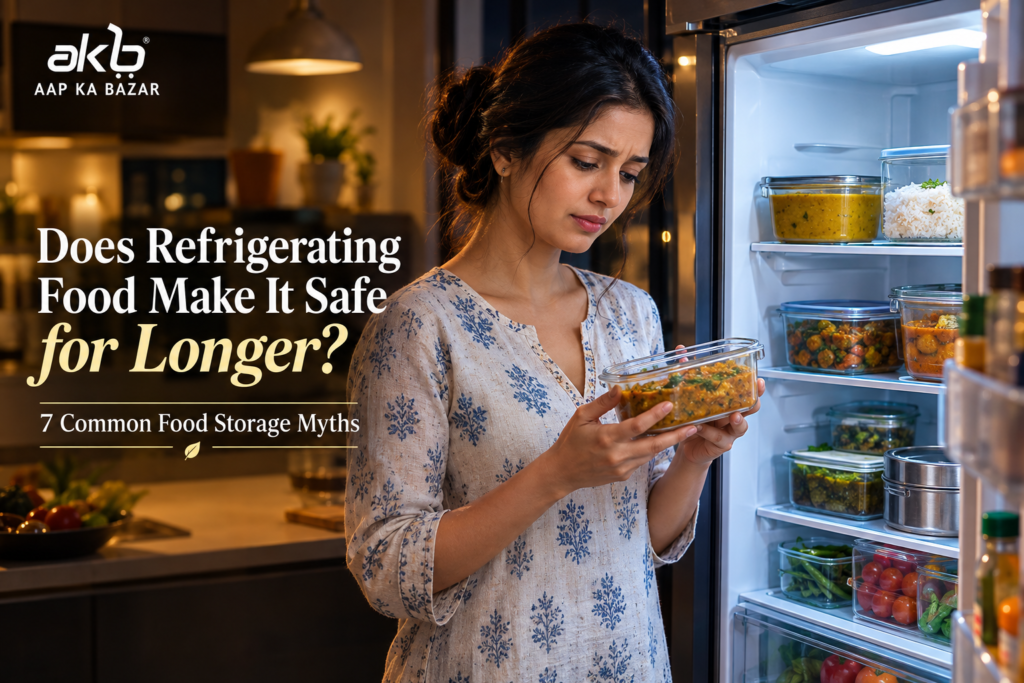

Putting food in the fridge slows things down, but it’s not some magic safety switch. That curry from last night might look totally fine sitting in there, smell fine too — and still not actually be okay to eat.
Most people have their own little rules about this. “It’s been in the fridge, so it’s fine.” “I’ll just give it a sniff first.” “As long as I heat it up properly, nothing can go wrong.” Makes sense on the surface, but food safety doesn’t really work off gut feeling alone.
Your fridge does matter — a lot, actually. But it’s not just about whether you have one. It’s how fast you get the food into it, how cold it’s actually running, the way you’ve stored things, and how many days it’s been sitting there. All of that adds up.
So does refrigeration keep food safe? Kind of, yes — but only up to a point. It slows down a lot of the bacteria that cause spoilage. It doesn’t stop them dead in their tracks.
With that out of the way, here are seven storage myths people believe way too often.
Myth 1: “If Food Is in the Fridge, It Is Safe for Any Amount of Time”
This is probably one of the most common refrigerator habits.
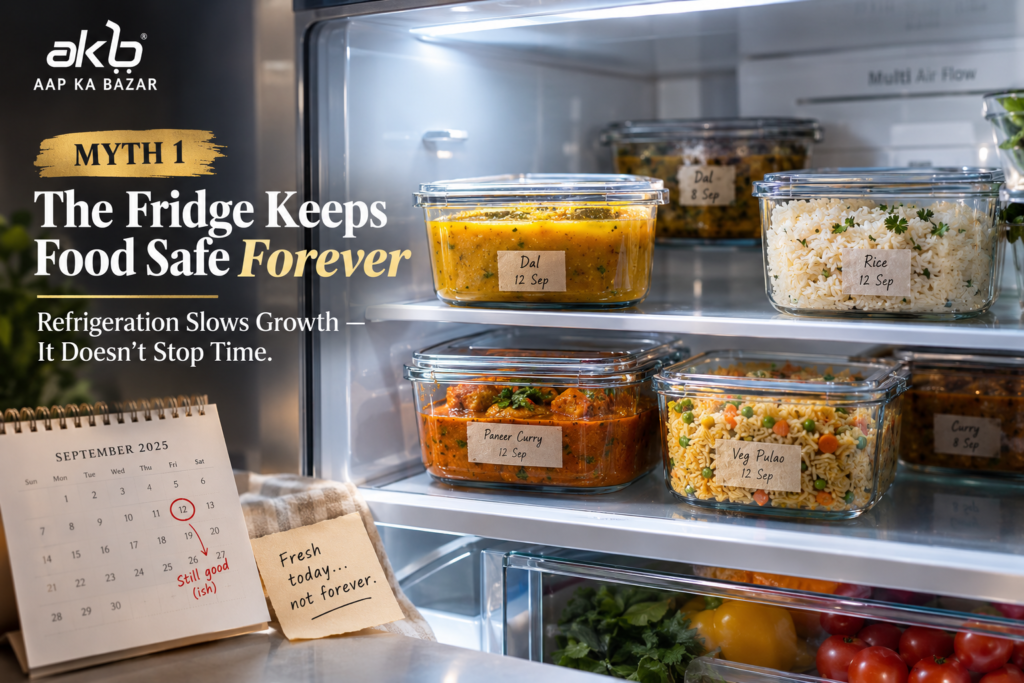
Refrigeration slows the growth of many bacteria, but it doesn’t completely stop microbial growth. Some microorganisms can continue to multiply at refrigerator temperatures.
That means putting a dish in the fridge doesn’t give it an unlimited shelf life.
For leftovers, a useful general rule is to eat refrigerated leftovers within about 3–4 days, provided they were handled and stored properly.
The exact storage time can vary depending on the food, preparation and storage conditions, so when in doubt, check reliable food-safety guidance rather than relying only on appearance.
The takeaway: Your refrigerator buys you time. It doesn’t freeze the clock.
Myth 2: “Hot Food Should Always Cool Completely Before Refrigerating”
You may have heard this advice at home: “Pehle khana thanda hone do, phir fridge mein rakhna.”
There is some logic behind avoiding a very large, steaming-hot pot in the refrigerator. It can raise the temperature inside the fridge and affect nearby food.
But leaving cooked food sitting out for several hours is not a better solution.
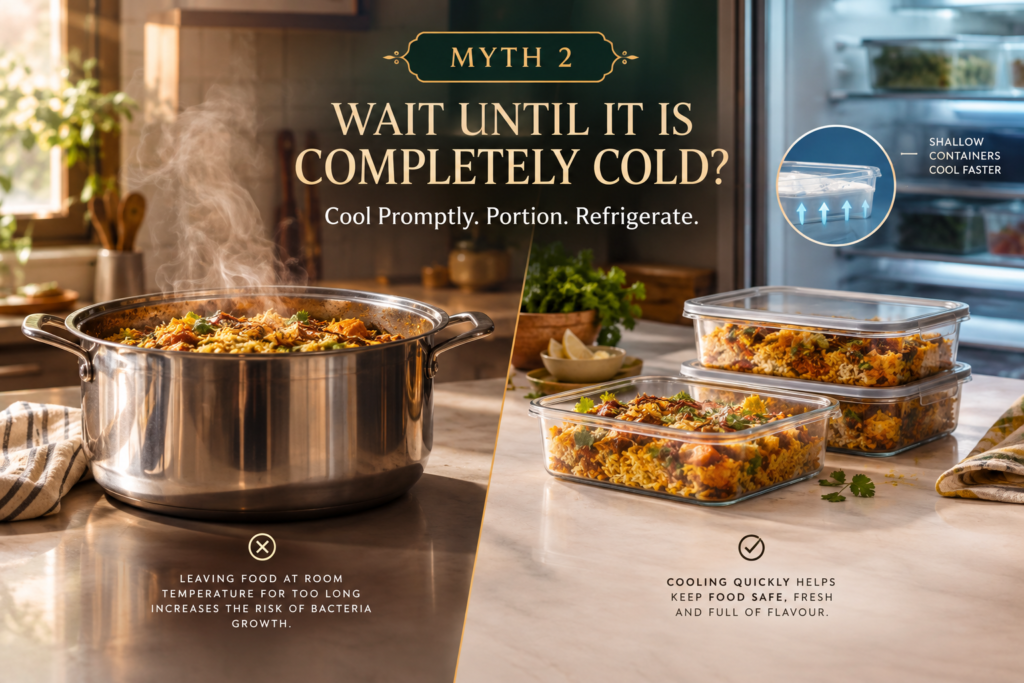
A safer approach is to divide large quantities of food into smaller, shallow containers. This allows the food to cool more quickly and makes refrigeration easier.
For perishable food, don’t leave it sitting at room temperature for long periods. Food-safety guidance commonly recommends refrigerating perishable foods within 2 hours, or within 1 hour when the surrounding temperature is above 32°C.
So instead of waiting for a huge pot of dal, curry or rice to become completely cold, portion it sensibly and refrigerate it promptly.
Myth 3: “If It Smells Fine, It Is Safe to Eat”
This is where our senses can sometimes mislead us.
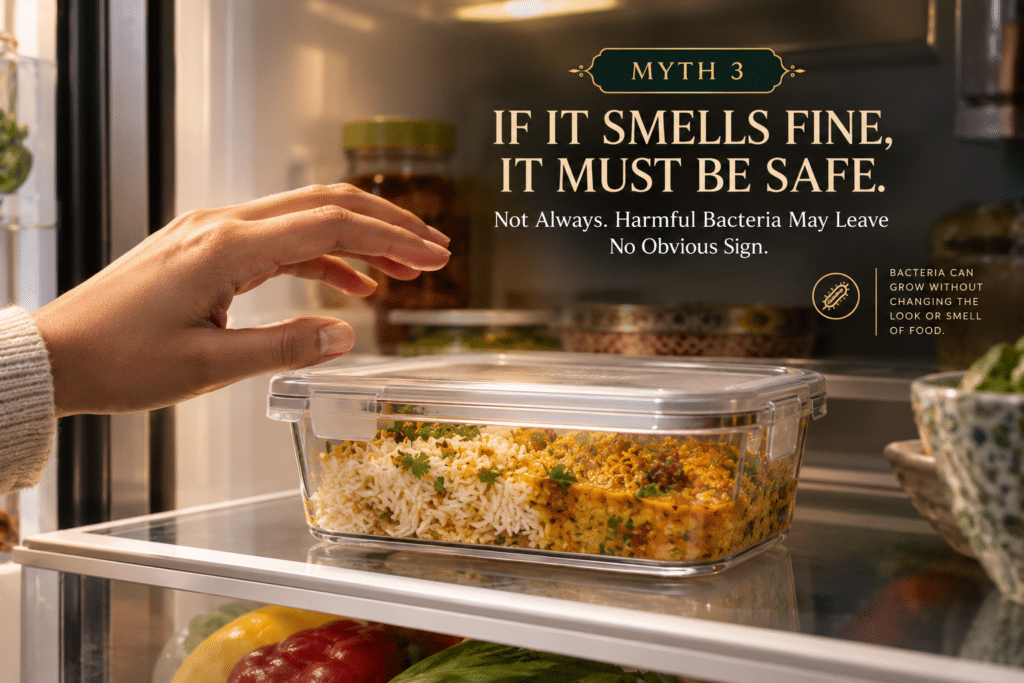
Smell, colour and appearance can help you notice obvious spoilage. But harmful bacteria may not always change the smell, taste or appearance of food.
So that leftover pulao that smells completely normal isn’t automatically safe simply because it passes the “smell test.”
This is especially important with cooked foods, dairy products, meat, seafood and other perishable items.
When it comes to food safety, don’t taste questionable food just to find out whether it is still good.
When you aren’t sure how long something has been stored or whether it was handled safely, throwing it away is safer than taking a chance.
Myth 4: “Reheating Food Makes Old Food Safe Again”
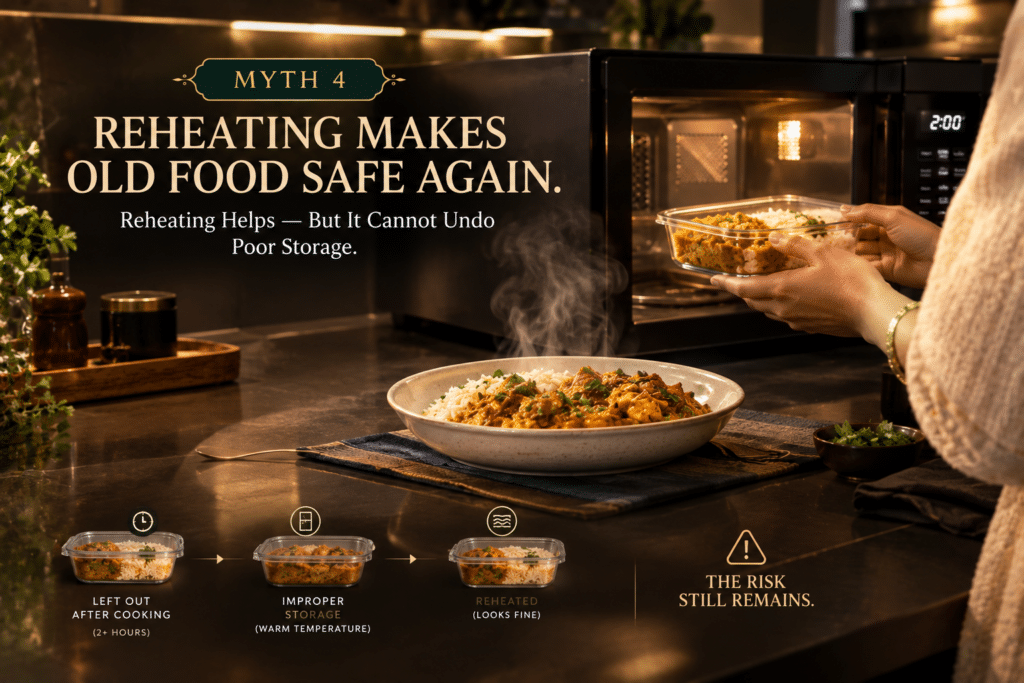
Reheating can kill many bacteria when food reaches an appropriate internal temperature.
But there is an important catch.
Some bacteria can produce toxins that may remain even after reheating. Reheating also cannot reverse poor storage practices or make food that has been sitting out for too long “new” again.
This is why reheating should not be treated as a rescue button for old food.
For leftovers, the safer routine is:
- Refrigerate them promptly.
- Store them in clean, covered containers.
- Keep your refrigerator properly cold.
- Reheat only the portion you plan to eat.
- Heat leftovers thoroughly before serving.
Good storage comes first. Reheating is not a replacement for it.
Myth 5: “The Refrigerator Is Cold Enough, So Temperature Doesn’t Matter”
Not every refrigerator maintains the same temperature.
For food safety, your refrigerator should generally be kept at 40°F / 4°C or below. A refrigerator thermometer can be useful because the number on a fridge’s temperature dial doesn’t always tell you the actual internal temperature.
Temperature can also vary inside the refrigerator.
For better storage:
- Don’t overload the fridge.
- Keep the refrigerator door closed as much as possible.
- Store food in covered containers.
- Check that your fridge is maintaining the recommended temperature.
- Don’t rely on the coldest-looking shelf as proof that everything is being stored safely.
A few degrees can make a meaningful difference when you’re storing perishable food.
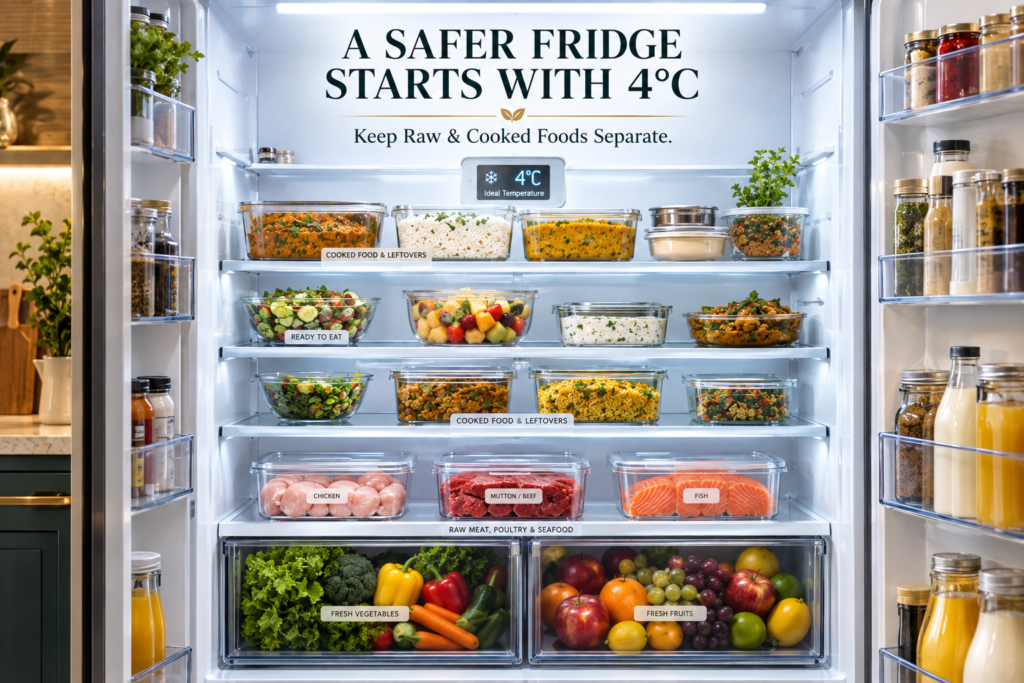
Myth 6: “You Can Put Everything in the Same Part of the Fridge”
Your refrigerator isn’t just a cold cupboard. Where you place food matters too.
Raw meat, poultry and seafood should be stored carefully to prevent their juices from dripping onto ready-to-eat foods.
A simple arrangement can help:
Top shelves:
Ready-to-eat foods, cooked leftovers and foods that don’t need cooking.
Lower shelf:
Raw meat, poultry and seafood in sealed containers or trays.
Drawers:
Fruits and vegetables, according to the storage needs of the particular produce.
Door:
Items that are less temperature-sensitive, while following the storage instructions on the packaging.
Keeping raw and cooked foods separated reduces the risk of cross-contamination.
Myth 7: “Freezing and Refrigerating Food Are Basically the Same”

Both refrigeration and freezing help extend the usable life of food, but they work differently.
Refrigeration slows bacterial growth.
Freezing stops the growth of bacteria, yeasts and moulds while the food remains frozen, although it does not necessarily kill all microorganisms.
Freezing is therefore useful when you know you won’t eat something within its normal refrigerated storage period.
However, freezing doesn’t magically make food safe if it was already mishandled before going into the freezer.
For example, freezing a dish that has already been sitting at room temperature for too long doesn’t undo the earlier food-safety risk.
Think of freezing as preserving food at an earlier point — not repairing spoiled food.
So, Does Refrigerating Food Make It Safe for Longer?
Yes — but only when refrigeration is combined with proper food handling.
Your refrigerator can significantly slow down spoilage and help extend the safe storage period of many foods. But several things need to work together:
1. Refrigerate promptly
Don’t leave perishable food sitting out unnecessarily.
2. Keep the refrigerator cold
Aim for 4°C / 40°F or below.
3. Use suitable containers
Covered, clean containers help protect food and reduce cross-contamination.
4. Label leftovers
If you regularly store cooked food, adding a simple date label can prevent the classic “When did we make this?” problem.
5. Follow package instructions
Packaged foods may have specific storage instructions that should take priority.
6. Don’t depend only on smell
Food can become unsafe without obvious signs of spoilage.
A Simple Refrigerator Rule to Remember
Instead of trying to memorise dozens of food-storage rules, remember this simple sequence:
COOK → COOL PROMPTLY → COVER → REFRIGERATE → USE ON TIME
And when you’re unsure about a questionable leftover, don’t take a bite just to test it.
Food safety is one area where “better safe than sorry” makes sense.
Final Takeaway
So — does keeping food in the fridge mean it’s safe for longer? Yeah, to some degree. It slows bacteria down and helps a lot of foods hold up better. But it’s not going to make anything last forever, no matter how cold your fridge is.
Honestly, most of the difference comes down to small stuff people don’t think about much — getting food into the fridge quickly instead of leaving it out, keeping the temperature where it should be, not letting raw meat touch stuff that’s already cooked, using containers that are actually clean, and just keeping some track of how long something’s been sitting in there. None of this is complicated, but skipping it is usually where things go wrong.
Your fridge genuinely does a lot for you in the kitchen — you just have to give it the right conditions to work with. Do that, and you’ll waste less food and worry less about what you’re feeding your family.
Want more tips like this around groceries, storage, and everyday kitchen stuff? Stick around on the Aap Ka Bazar Blog.