

Spices play a vital role in Indian cuisine. From turmeric to cumin, from coriander to black pepper, every day our masalas give flavor, color, and aroma to every dish that we prepare. However, due to increasing knowledge about food quality and adulteration, one question that arises Organic vs Regular Spices which one is best.
Let’s look at the real difference between the two and whether organic spices are worth the extra cost.
Organic vs Regular Spices: What’s the Difference?
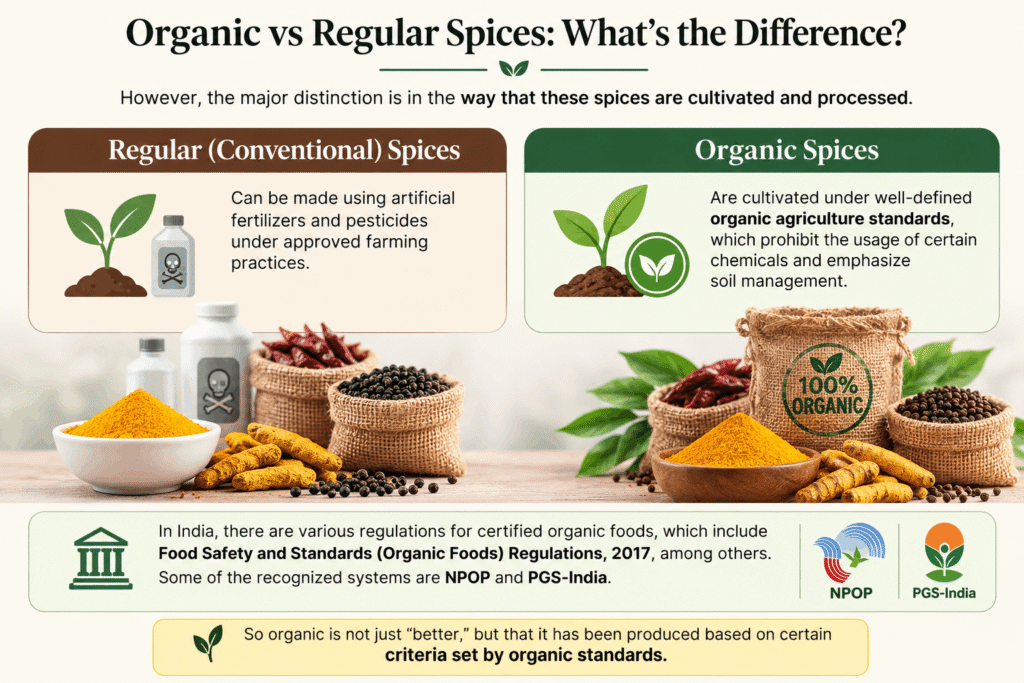
However, the major distinction is in the way that these spices are cultivated and processed.
Regular or conventional spices can be made using artificial fertilizers and pesticides under approved farming practices.
In contrast, organic spices are cultivated under well-defined organic agriculture standards, which prohibit the usage of certain chemicals and emphasize soil management.
In India, there are various regulations for certified organic foods, which include Food Safety and Standards (Organic Foods) Regulations, 2017, among others. Some of the recognized systems are NPOP and PGS-India.
So organic is not just “better,” but that it has been produced based on certain criteria set by organic standards.
Are Organic Spices Free of Pesticide Residue?
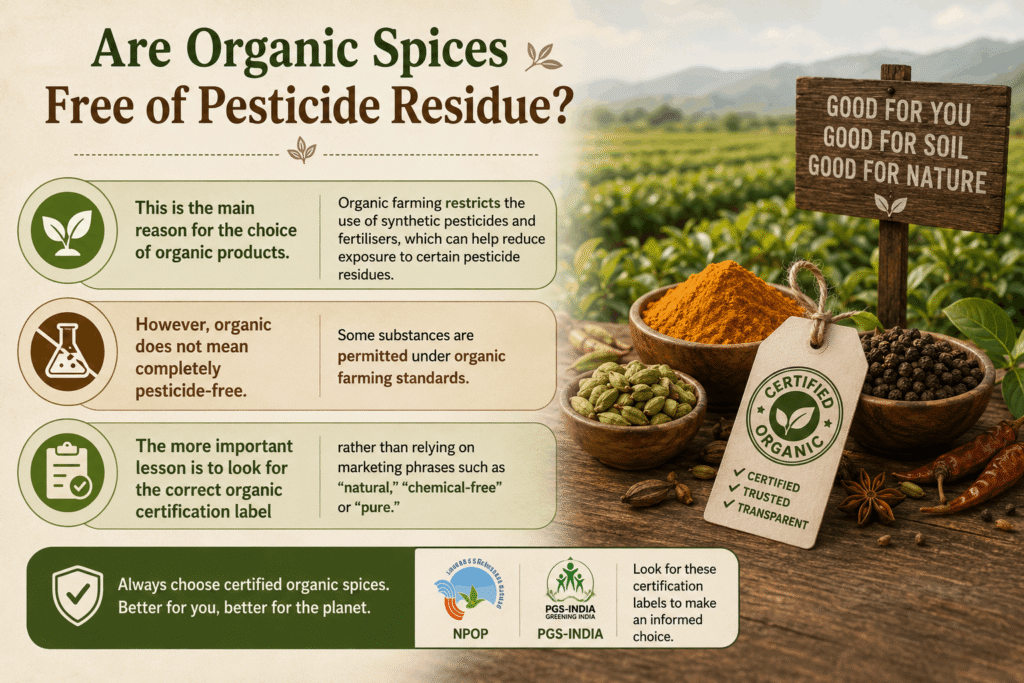
This is the main reason for the choice of organic products.
Organic farming restricts the use of synthetic pesticides and fertilisers, which can help reduce exposure to certain pesticide residues.
However, organic does not mean completely pesticide-free. Some substances are permitted under organic farming standards.
The more important lesson is to look for the correct organic certification label rather than relying on marketing phrases such as “natural,” “chemical-free” or “pure.”
Why are Organic Spices More Expensive?
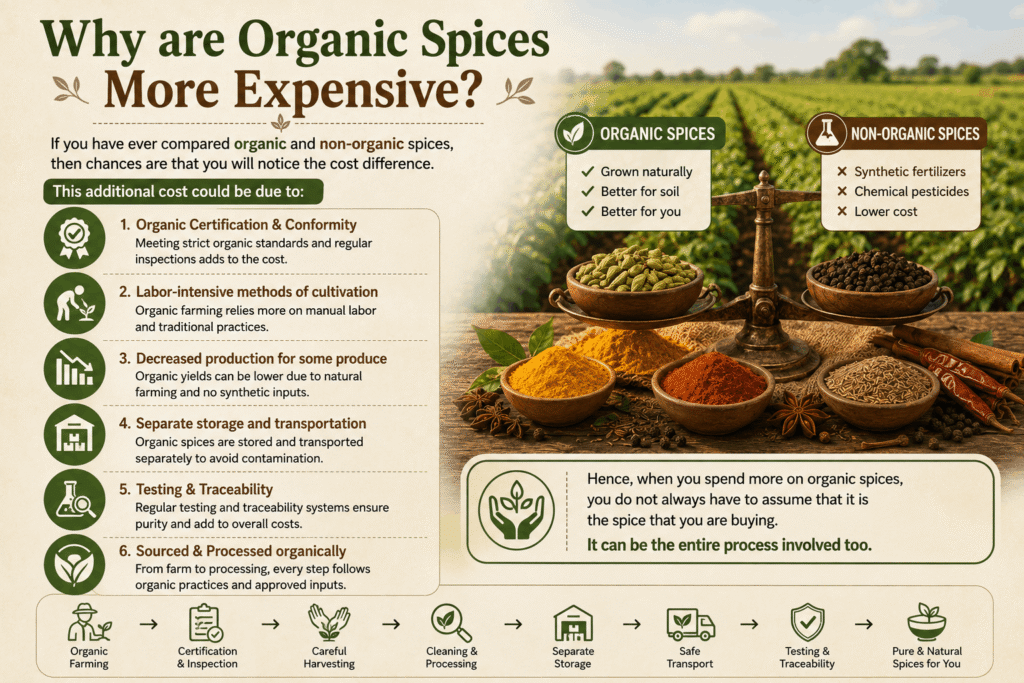
If you have ever compared organic and non-organic spices, then chances are that you will notice the cost difference.
This additional cost could be due to:
- Organic Certification & Conformity
- Labor-intensive methods of cultivation
- Decreased production for some produce
- Separate storage and transportation
- Testing & Traceability
- Sourced & Processed organically
Hence, when you spend more on organic spices, you do not always have to assume that it is the spice that you are buying. It can be the entire process involved too.
Not Always Adulteration Free Because Organic
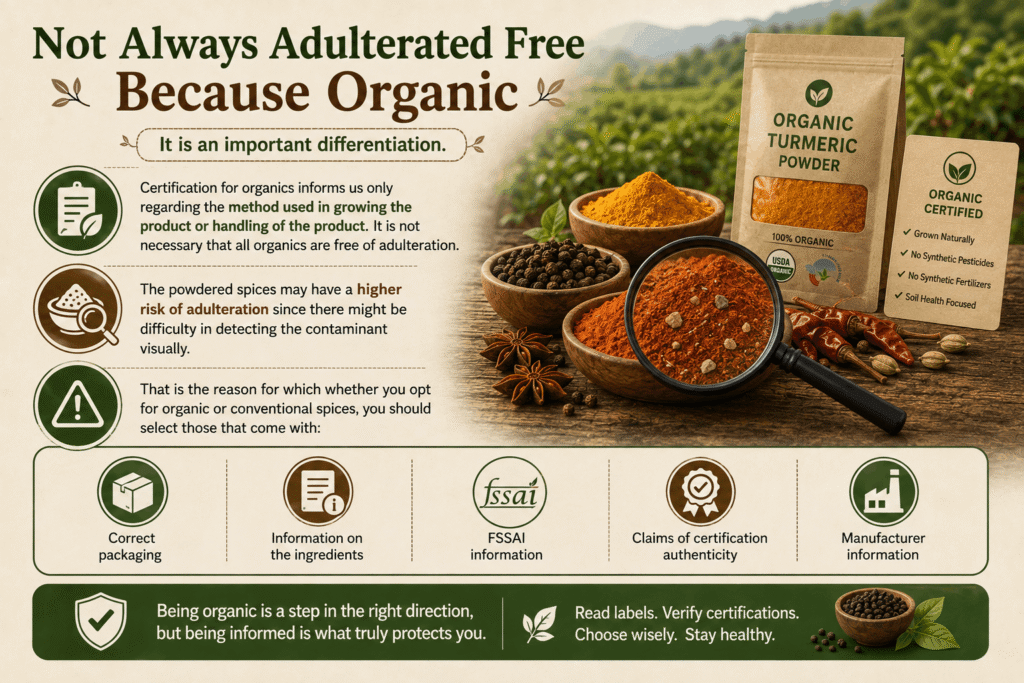
It is an important differentiation.
Certification for organics informs us only regarding the method used in growing the product or handling of the product. It is not necessary that all organics are free of adulteration.
The powdered spices may have a higher risk of adulteration since there might be difficulty in detecting the contaminant visually.
That is the reason for which whether you opt for organic or conventional spices, you should select those that come with:
- Correct packaging
- Information on the ingredients
- FSSAI information
- Claims of certification authenticity
- Manufacturer information
Organic or Conventional: Which to Select?
There is no universal solution for everyone.
If you value certified organic farming methods, sustainability and minimizing your potential exposure to certain artificial pesticides, then go for organic spices.
Regular spices may also prove to be a great choice, provided they are produced by reputable manufacturers who comply with all safety standards.
You can also consider buying whole spices such as cumin, coriander, black pepper and cardamom. Grinding them at home can give you greater control over what goes into your masala.
How to Buy Better Organic Spices
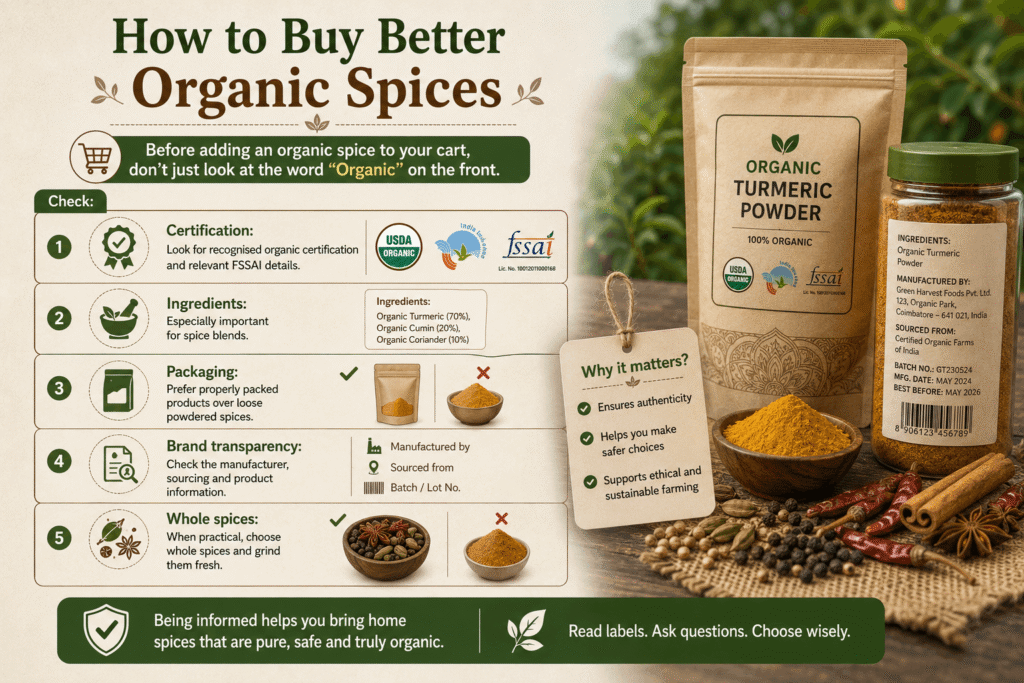
Before adding an organic spice to your cart, don’t just look at the word “Organic” on the front.
Check:
- Certification: Look for recognised organic certification and relevant FSSAI details.
- Ingredients: Especially important for spice blends.
- Packaging: Prefer properly packed products over loose powdered spices.
- Brand transparency: Check the manufacturer, sourcing and product information.
- Whole spices: When practical, choose whole spices and grind them fresh.
Conclusion: Is the Purchase of Organic Spices Worthy?
Organic spices can be considered worthy of the price premium, if you value their production certifications and practices.
However, organic is not the sole determining factor in assessing the quality of spices.
Regardless of your choice between organic or conventional spices, always consider the authenticity, correct packaging, labeling, and sourcing.
This is because your spice box may contain only a few basic spices, which, however, you will use in almost every dish you cook.
You can buy all your favourite organic spices from Aap Ka Bazar—quality, variety, and everyday goodness, all in one place.